The Hidden Engine of Prediction Markets
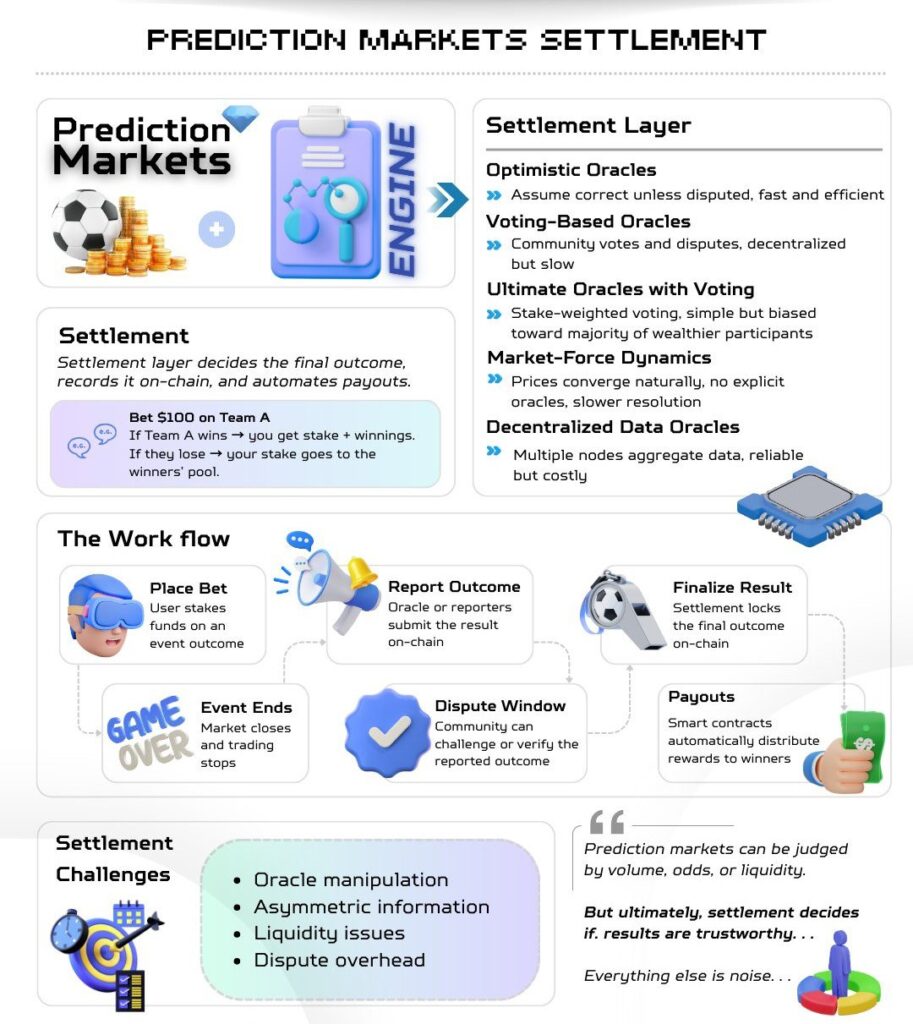
Prediction markets go beyond mere betting. The true strength lies in the settlement layer – the system that finalizes outcomes on-chain and distributes rewards. This layer is essential for establishing trust and moving beyond mere speculation.
How Settlement Works
Settlement is straightforward: if you wager $100 on Team A and they emerge victorious, the system recognizes your correct prediction and pays out your stake along with winnings. Conversely, if they lose, your bet contributes to the winners’ pool. Through settlement, results become conclusive, automated, and impartial.
How it Works
After an event concludes, an oracle or reporter submits the outcome. A brief dispute period allows the community to contest the result. Once resolved, smart contracts execute payouts.
Different Models
- Optimistic oracles: Assume correctness unless challenged (efficient and cost-effective).
- Voting-based oracles: Depend on community voting (decentralized but slower).
- Stake-weighted voting: Provides more influence to larger holders (straightforward but favors major holders).
- Market dynamics: Enable natural price convergence (no explicit oracle, but slower).
- Decentralized data oracles like Chainlink: Aggregate information from various nodes (reliable yet costly).
Challenges
Challenges include oracle manipulation, insider advantages, low liquidity, and prolonged dispute resolutions. Each method involves trade-offs between speed, cost, and decentralization.
Prediction markets can be evaluated based on liquidity or odds, but ultimately, it is the settlement process that determines the reliability of outcomes. This distinction is what separates mere noise from truth.
Also read: Hyperliquid’s Native Stablecoin Battle: 3 Proposals in Race